




Curtain Measuring Guides

Proper measuring is essential for a perfect fit. Follow this step-by-step guide for accurate measurements for all curtain types, including pencil pleat, eyelet, and wave curtains.
Classic Window
Below is a straightforward step-by-step guide to measure curtains for classic windows.
Tools Required:
Measuring tape, Spirit level, Pencil, Drill and Screwdriver

Step 1 — Before You Measure
- Fit your track or pole if it is not already in place.
- Always use a metal measuring tape and record measurements in millimetres (mm).
- Measure width first, then drop (top to bottom).
- Check for obstructions such as window handles, radiators, or vents.
- Double-check all measurements.
Step 2 — Measuring Width
Curtain Track
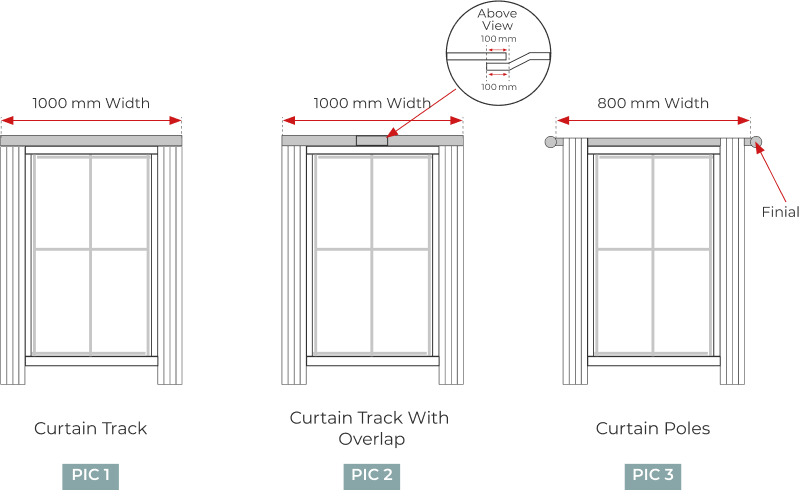
- Measure end to end of the track and record as your width (as shown in PIC 1)
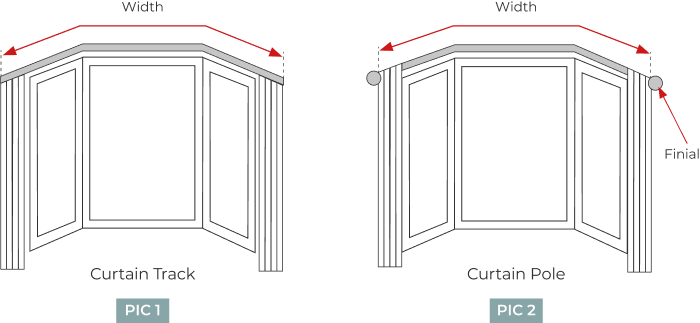
- For curtain tracks, measure each section of the bay (left, middle, right) end to end, including any corner bends, as shown in PIC 1. Please record all measurements in millimetres (mm).
Curtain Pole
- Measure between the finials (excluding the finials) and record as the width.
- Check corners and joins if you are using eyelet curtains to ensure the eyelets can slide smoothly.
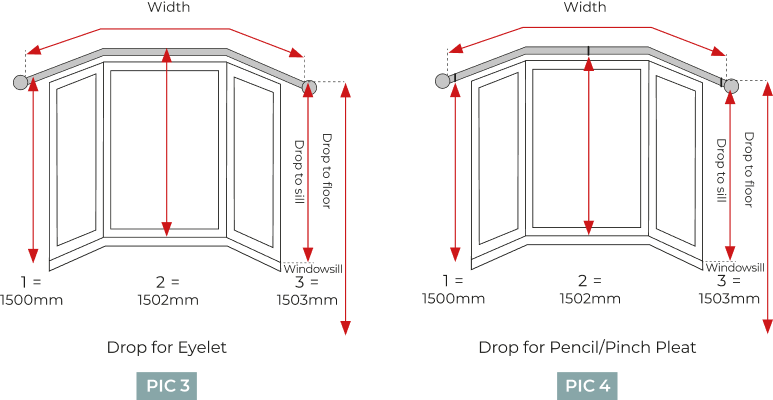
- Measure the track supplied with the curtains from end to end; this will be your curtain width. (as shown in PIC 3)
Note: Never provide the curtain size you require. Our curtains are made to fit the track/pole size required.
Step 3 — Measuring Drop
Eyelet Curtains
- Measure from the top of the pole to the desired finish point.
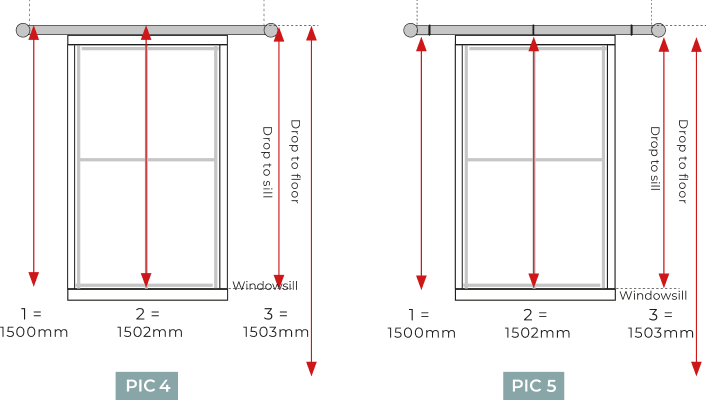
- Take three measurements (left, centre, right) and use the shortest. (e.g. in PIC 4 measurement will be 1500mm)
- Curtains will fit poles up to 35mm or 45mm diameter depending on eyelet size.
- Overall drop will be 30mm longer to allow the curtain to stand off the pole
Pencil Pleat/Pinch Pleat Curtains
Decide whether the curtain will cover the track/pole or sit under the track/pole (on the rings).
Cover Track/Pole:
- Measure from the top of the track/pole to the desired finish. Take three measurements and record the shortest.
Under Track/Pole:
- Measure from the ring/hook to the desired finish. Take three measurements and record the shortest.
Wave:
- Measure from the top of the supplied track to the desired drop.
- Take three measurements and record the shortest.
Step 4 — Overlaps & Obstructions
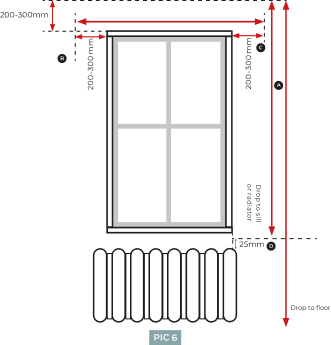
Allow a 200–300 mm overlap on each side and above the window, if space permits (PIC 4).
Take note of any obstacles along the curtain path that may affect curtain movement or installation (PIC 4).
Step 5 — Final Checks
- Recheck all width and drop measurements.
- Ensure tracks/poles are level and securely fixed.
- Confirm that curtains will move freely without obstruction.
Bay Window
Below is a straightforward step-by-step guide to measure curtains for bay windows.
Tools Required:
Measuring tape, Spirit level, Pencil, Drill and Screwdriver
Step 1 — Before You Measure
- Fit your bay window track or pole first. Bay windows require special consideration for corners.
- Use a metal measuring tape and record measurements in mm.
- Measure width first, then drop.
- Check for obstructions at the corners or around handles.
- Recheck all measurements for accuracy.
Step 2 — Measuring Width
- For curtain tracks, measure each section of the bay (left, middle, right) end to end, including any corner bends. (as shown in PIC 2). Please record in mm.
- For poles, measure between finials for each section. (as shown in PIC 2). Please record in mm.
- For eyelet curtains, check that the pole allows the eyelets to slide around all corners.
- For wave curtains, measure along the supplied track for each section.
Step 3 — Measuring Drop
- Follow the same process as for classic windows:
- Eyelet Curtains: Measure from top of pole to desired finish. Shortest of three points per section. (e.g as in PIC 3 will be 1500mm)
- Pencil/Pinch Pleat Curtains: Decide whether covering or under track, measure accordingly. (e.g as in PIC 4 will be 1500mm)
- Wave Curtains: Measure from top of supplied track to desired drop. Shortest measurement per section.
Step 4 — Overlaps & Obstructions
- Bay windows often require extra width at corners to ensure proper curtain stacking.
- Allow 200–300mm overlap beyond each end of the bay if space permits.
- Note any obstacles such as window handles or radiators.
Step 5 — Final Checks
- Recheck all width and drop measurements.
- Ensure tracks/poles are level and securely fixed.
- Confirm that curtains will move freely without obstruction.